Exploring the cutting-edge research on feline consciousness, social identity, and what cats really think about themselves.
—
Introduction: The Question That Fascinates Every Cat Owner
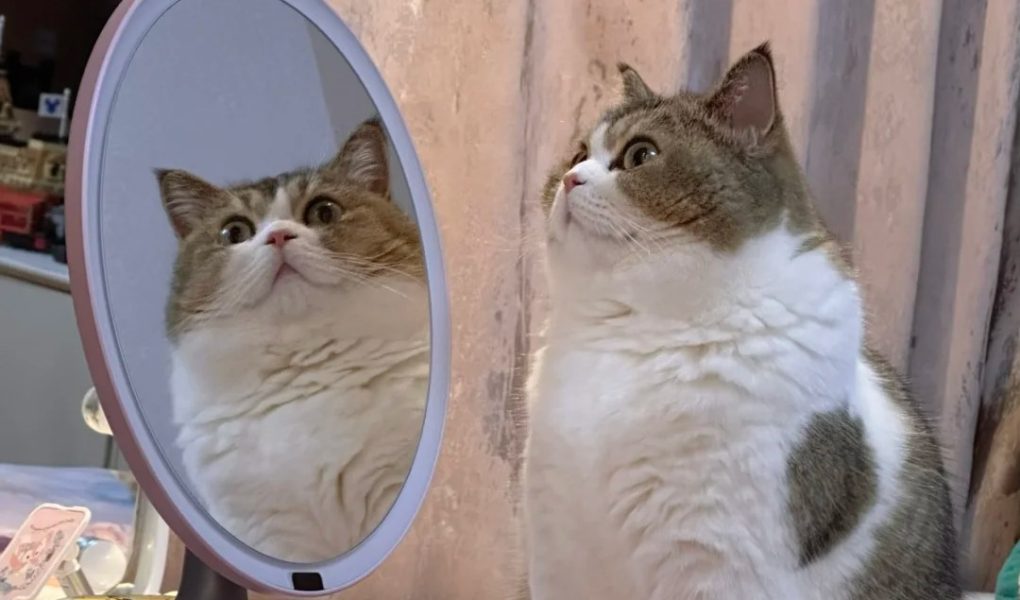
If you’ve ever watched your cat watching themselves in a mirror, you’ve probably wondered: do they recognize themselves? Do they know they’re a cat? And if they do recognize their reflection, what do they think they’re looking at?
The question of feline self-awareness touches on some of the most profound topics in animal cognition and consciousness. While we can’t simply ask our cats what they think, decades of scientific research have given us fascinating insights into how cats perceive themselves, other cats, and their place in the human world.
This question matters more than you might think. Understanding feline self-perception can help us provide better care, create stronger bonds, and appreciate the remarkable complexity of the creatures who share our homes.
—
The Mirror Test: What It Really Tells Us
The Classic Self-Recognition Test
The mirror test, developed by psychologist Gordon Gallup in 1970, has become the gold standard for assessing self-recognition in animals. The test is simple but profound: an animal is quietly marked with a colored spot in a place they can’t see without a mirror. Then, they’re presented with a mirror.
The Two Possible Responses:
1. Social Response: The animal treats their reflection as another individual—threatening it, trying to play with it, or ignoring it entirely.
2. Self-Directed Behavior: The animal recognizes the reflection as themselves and uses the mirror to investigate the mark on their own body.
Animals That Pass:
- • Great apes (chimpanzees, orangutans, gorillas)
- • Bottlenose dolphins
- • Asian elephants
- • Eurasian magpies
- • Cleaner wrasses (controversially)
How Cats Respond to Mirrors
Research on cats and mirrors has produced intriguing, sometimes contradictory results.
Common Cat Behaviors with Mirrors:
| Behavior | Interpretation |
| Aggression | Treating reflection as intruder |
| Fear/Alertness | Uncertain about the “other cat” |
| Curiosity followed by indifference | Brief interest, then dismissal |
| Ignoring entirely | Complete lack of interest |
| Playing | Treating as interactive toy |
What This Suggests:
Many researchers believe that a cat’s typical response—initial interest followed by indifference or aggression—indicates they may recognize that the reflection isn’t a “real” cat, but they don’t connect it to themselves.
The Limitations of the Mirror Test
Critics argue that the mirror test may not be fair to all animals, especially those that rely primarily on senses other than vision.
Test Limitations:
- • Visual vs. Sensory Primacy: Cats rely heavily on smell; mirrors test only visual self-recognition
- • Different Social Structures: Dogs and cats interact differently with social cues
- • Motivation Matters: The test requires the animal to care about marks on their body
- • Alternative Explanations: Some responses could indicate self-recognition without self-awareness
The Case for Cats:
Some researchers suggest that cats may recognize themselves but simply not care enough about body marks to investigate. After all, cats are notoriously independent and may have different priorities than primates.

The Science of Cat Consciousness
What Do We Mean by “Knowing You’re a Cat”?
Before we can answer whether cats know they’re cats, we need to define what we mean by this question.
Levels of Self-Awareness:
1. Physical Self-Awareness: Recognizing your own body as distinct from the environment
2. Self-Recognition: Identifying yourself in a mirror or photograph
3. Self-Concept: Having a mental representation of yourself as a type of being
4. Autobiographical Self: Understanding your past and future as part of your identity
The Spectrum Question:
A cat might:
- • Know their own body (physical self-awareness) ✓ Likely
- • Recognize themselves in mirrors (self-recognition) ? Uncertain
- • Understand they’re a “cat” as a category (self-concept) ? Very uncertain
- • Have a sense of personal identity (autobiographical self) ? Uncertain
Feline Cognitive Abilities
Recent research has revealed surprising cognitive abilities in cats that may relate to self-awareness.
Documented Cat Cognition:
| Ability | Evidence | Significance |
| Object Permanence | Finding hidden food | Understands objects exist even when out of sight |
| Causal Reasoning | Choosing correct tool | Understands cause and effect |
| Social Learning | Watching and imitating | Can learn from observing others |
| Memory | Remembering locations, routines | Has long-term and short-term memory |
| Emotion Recognition | Responding to human emotions | Perceives human emotional states |
| Communication | Complex vocalizations | Intentionally communicates needs |
Do Cats Have a “Cat Identity”?
This is perhaps the most fascinating and unanswerable question.
Arguments FOR Cat Self-Concept:
- • Cats behave differently around other cats vs. humans
- • Mother cats recognize their kittens
- • Cats have species-typical behaviors (grooming, hunting postures)
- • Social hierarchies exist in multi-cat households
- • Cats can distinguish between species
Arguments AGAINST Cat Self-Concept:
- • No evidence of self-categorization as “cat”
- • Cats don’t seem to have species pride
- • Cross-species bonding is common
- • No evidence of abstract self-categorization
- • Limited evidence of complex self-reflection
The Pragmatic Answer:
Cats likely have a functional understanding of what cats are—they recognize cat features, sounds, and smells. But whether they have an abstract concept of “cat-ness” or understand themselves as members of the species “Felis catus” remains unknown.
—
How Cats Perceive Other Cats
Social Recognition
Cats have remarkably sophisticated ways of recognizing and categorizing other cats.
Recognition Methods:
- • Olfactory Signatures: Each cat has a unique scent profile
- • Vocal Recognition: Distinguish familiar from unfamiliar cats
- • Visual Recognition: Recognize faces and body patterns
- • Behavioral Cues: Interpret body language and posture
Cat-to-Cat Relationships
Cats form complex social structures, especially in colony settings.
Social Behaviors:
- • Allogrooming: Mutual grooming between cats
- • Allorubbing: Head-body rubbing to share scents
- • Hunting Coordination: Sometimes hunt cooperatively
- • Resource Sharing: Can share food and space
- • Hierarchies: Often establish dominance structures
What Makes a Cat “Cat-like” to Another Cat?
Research suggests that cats recognize conspecifics (members of their own species) through a combination of factors.
Key Recognition Factors:
1. Scent Profile: The most important identifier
2. Physical Features: Size, ear shape, whisker pattern
3. Behavioral Cues: How cats move and interact
4. Vocalizations: Species-specific sounds
5. Grooming Patterns: Self-grooming behaviors

The Human-Cat Relationship: A Unique Bond
Cross-Species Recognition
Cats seem to recognize humans as something different from themselves, but important in their world.
Evidence of Human Recognition:
- • Cats behave differently with familiar vs. unfamiliar humans
- • Many cats show stress when separated from their owners
- • Some cats sleep on their owners (vulnerable position = trust)
- • Cats can recognize their names (several studies confirm)
- • Greeting behaviors differ for humans vs. other stimuli
The “Large Cat” Hypothesis
Some researchers and cat behaviorists have suggested that cats may perceive humans as a type of large, strange-looking, non-predatory cat.
Supporting Evidence:
- • Cats knead and purr on humans (similar to mother behavior)
- • Cats bring “gifts” (dead prey) to owners
- • Greeting behaviors (head bunting, rubbing) are cat-to-cat behaviors
- • Territorial behavior includes the owner’s space
- • Cats show similar stress responses to owner absence as to kitten absence
Counter-Evidence:
- • Cats don’t show submission postures to humans
- • Many cats treat humans very differently from other cats
- • Predator-prey dynamics can exist (small humans may trigger hunting)
- • Greeting behaviors may have been transferred to humans
- • The relationship appears unique, not simply “cat-to-cat”
Do Cats Think Humans Are Bad at Being Cats?
This amusing hypothesis suggests that cats may view humans as incompetent cats who can’t hunt properly, don’t understand cat communication, and have strange behaviors.
The “Benign Supervisor” Theory:
Some researchers suggest cats view humans as:
- • Large, warm beds (comfort source)
- • Food providers (but terrible hunters)
- • Grooming assistants (though bad at it)
- • Territorial allies (helpful for defending space)
- • Social companions (when convenient)
The “Parent Figure” Theory:
Others suggest cats view us more like mother cats:
- • We provide food
- • We offer warmth and comfort
- • We engage in mutual grooming (petting)
- • We protect them from threats
- • We’re the “safe base” in uncertain situations

Cat Intelligence: What Research Tells Us
The Shocking Truth About Cat Cognition
For decades, cats were considered less intelligent than dogs. Recent research has revealed this assumption was wrong—we just didn’t know how to test cats properly.
Revolutionary Findings:
| Discovery | Researcher/Year | Significance |
| Name Recognition | Saito et al., 2019 | Cats recognize their names |
| Pointing Understanding | Miklósi et al., 2005 | Cats follow human pointing |
| Scent Memory | Fellers et al., 1997 | Superior long-term memory |
| Social Learning | Pongrácz et al., 2019 | Cats learn from observation |
| Emotion Reading | Galvan et al., 2018 | Cats read human emotions |
Cat Learning and Problem-Solving
Cats are exceptional learners when motivated.
Learning Characteristics:
- • Food Motivation: Highly effective training incentive
- • Observation Skills: Can learn by watching (social learning)
- • Problem-Solving: Can figure out puzzles and mechanisms
- • Selective Attention: Focus on what matters to them
- • Independence: Less likely to seek approval than dogs
Memory and Recognition
Cats have remarkable memory capabilities.
Memory Studies:
- • Long-Term Memory: Remember significant events for years
- • Object Memory: Remember locations of hidden objects
- • Social Memory: Remember people and other animals
- • Spatial Memory: Navigate complex environments
- • Training Memory: Remember learned behaviors indefinitely
Implications for Self-Recognition:
A creature with such sophisticated memory and social cognition may have more complex self-representation than we assume.

The Emotional Lives of Cats
Do Cats Have Feelings?
The question of feline emotions has been debated for years. Current evidence strongly suggests cats experience a range of emotions.
Documented Feline Emotions:
| Emotion | Evidence | Behavioral Signs |
| Fear | Universal response | Dilated pupils, hiding, aggression |
| Joy | Reward-seeking behavior | Purring, play, slow blinks |
| Anxiety | Stress responses | Over-grooming, inappropriate elimination |
| Anger | Defensive/aggressive behavior | Ears back, hissing, growling |
| Affection | Bonding behaviors | Kneading, head bunting, sleeping near |
| Jealousy | Rivalry behaviors | Competition for resources/attention |
| Grief | Loss responses | Behavior changes after companion death |
Emotional Self-Awareness
If cats have emotions, do they know they’re experiencing them?
Signs of Emotional Complexity:
- • Purring for Multiple Reasons: Different purr patterns for different needs
- • Play Behavior: Shows cats can experience joy/fear simultaneously
- • Grief Responses: Behavior changes after loss suggest emotional awareness
- • Redirected Aggression: Shows cats recognize their emotional states
The Self-Awareness Question:
Emotional self-awareness—the ability to recognize and reflect on your own emotional states—may be separate from cognitive self-awareness. Cats may feel without explicitly knowing they’re feeling.
The Purr-Fect Example
The cat purr is a fascinating window into feline communication and possibly self-expression.
Purr Variations:
- • Happiness Purr: Soft, rhythmic, accompanied by relaxed body language
- • Food-Seeking Purr: Higher frequency, mixed with meows
- • Stress Purr: May indicate self-soothing behavior
- • Healing Purr: 25-150 Hz frequency promotes bone healing
- • Communication Purr: Specifically tuned to attract human attention
The fact that cats have developed purring specifically to communicate with humans suggests remarkable social intelligence and adaptability.
—
What Can We Conclude?
The Best Available Answer
Based on current research, here’s what we can reasonably conclude:
What Cats Probably Know:
1. Their Own Body: Cats show clear awareness of their physical capabilities
2. Their Individual Identity: They recognize their scent, territory, and routines
3. Other Cats: They can distinguish cats from other species
4. Humans: They recognize humans as a distinct category
5. Their Needs: They clearly communicate their desires and discomforts
What Cats Probably Don’t Know:
1. Abstract Self-Categorization: Whether they “know” they’re a “cat” in an abstract sense
2. Human Self-Awareness: They likely don’t understand human emotions/cognition
3. Complex Self-Reflection: Thinking about thinking (metacognition) remains unproven
What Remains Unknown:
1. Conscious Self-Awareness: Whether cats have conscious experiences of being “a cat”
2. Future Planning: The extent of autobiographical self-awareness
3. Abstract Concepts: Whether cats can think in abstract categories about themselves
The Philosophical Dilemma
The question “Do cats know they’re cats?” touches on one of philosophy’s greatest mysteries: the nature of consciousness itself.
The Hard Problem of Consciousness:
Why and how subjective experiences arise from physical processes remains unexplained. We can’t prove cats (or other humans) have subjective experiences—we can only observe their behavior.
The Ethical Implications:
Whether or not cats have complex self-awareness, they are sentient beings capable of experiencing pleasure and suffering. This should guide how we treat them regardless of their exact level of self-recognition.
What This Means for Cat Owners
Practical Takeaways:
1. Cats Are Complex: Don’t underestimate feline cognition and emotions
2. Individual Differences: Each cat has unique personality and preferences
3. Respect Their Nature: Working with, not against, cat instincts strengthens bonds
4. Environmental Enrichment: Challenge your cat’s mind
5. Emotional Care: Cats need emotional support and stable environments
The Bond We Share:
What we do know with certainty is that cats form deep, meaningful bonds with their humans and with other cats. Whether or not they have complex self-awareness, they experience joy, comfort, fear, and affection. And that’s what truly matters.

Conclusion: The Beautiful Mystery
The question “Do cats know they’re cats?” may never have a definitive answer. The nature of consciousness—whether in cats, dogs, or humans—remains one of science’s greatest mysteries.
What we do know is that cats are remarkable creatures with sophisticated cognition, rich emotional lives, and complex relationships. They recognize us, communicate with us, and form genuine bonds with us. Whether they understand the abstract concept of “cat-ness” may be less important than the daily reality of sharing our lives with these fascinating, infuriating, lovable animals.
Perhaps the real answer isn’t about what cats know about being cats. Perhaps it’s about what we’ve come to know about cats through centuries of companionship—and how much more there is still to discover.
What we can say with confidence:
Cats know what matters to them. They know their needs, their desires, their comfort and discomfort. They know who their people are. And they know—perhaps better than any philosopher ever could—that a warm sunbeam, a comfortable lap, and a life lived on their own terms is exactly what it means to be a cat.
—
Do you have a story about your cat’s behavior that suggests self-awareness? Share in the comments below!
—

_来自小红书网页版-320x200.jpg)