Discover the majestic beauty, incredible athleticism, and untamed spirit of Africa’s most graceful feline predator.
—
Introduction: The Spirit of the African Savannah
In the golden grasslands of sub-Saharan Africa, where the horizon stretches endlessly and the sun paints the earth in hues of amber and bronze, roams one of nature’s most exquisite feline creations—the Serval. With its impossibly long legs, oversized ears, and striking spotted coat, the Serval embodies the raw elegance and predatory perfection that has evolved over millennia in one of the world’s most demanding environments.
The Serval is not merely a cat; it is a masterpiece of evolutionary engineering. Every aspect of its being—the elongated limbs that allow it to peer over tall grasses, the radar-dish ears that can detect prey underground, the explosive leaping ability that defies gravity—speaks to a predator perfectly adapted to its domain. To observe a Serval in its natural habitat is to witness poetry in motion, a living testament to the beauty and efficiency of wild nature.

Origins and Evolution: Born of the African Plains
Ancient Ancestry
The Serval (Leptailurus serval) represents one of the oldest feline lineages in Africa, having roamed the continent for millions of years. Genetic studies suggest that Servals diverged from other wild cats approximately 5.4 million years ago, making them one of the most ancient feline species still in existence.
Evolutionary Adaptations:
| Feature | Adaptation | Purpose |
| Long Legs | Longest legs relative to body size | See over tall savannah grass |
| Large Ears | Largest ears of any cat | Detect prey underground |
| Long Neck | Extended cervical vertebrae | Spot prey from distance |
| Spotted Coat | Camouflage pattern | Blend with grassland shadows |
| Explosive Leaping | Powerful hind leg muscles | Pounce on prey from distance |
| Slender Body | Streamlined build | Move silently through grass |
Geographic Distribution
Servals are found throughout sub-Saharan Africa, with their range extending from the southern edge of the Sahara to South Africa. Their adaptability has allowed them to thrive in various habitats, though they show distinct preferences.
Preferred Habitats:
- • Savannah Grasslands: Primary habitat, tall grass for hunting
- • Wetlands and Marshes: Abundant prey, water access
- • Reed Beds: Dense cover, rich rodent populations
- • Forest Edges: Transition zones with diverse prey
- • Agricultural Areas: Adapted to human-modified landscapes
Range Countries:
South Africa, Kenya, Tanzania, Botswana, Zambia, Zimbabwe, Mozambique, Angola, Democratic Republic of Congo, Uganda, Rwanda, Burundi, Ethiopia, Somalia, Senegal, Guinea, and numerous other African nations.
The Serval in Human History
Throughout African history, Servals have held various places in human culture and mythology. Ancient Egyptians revered them, often depicting them in art and possibly keeping them as exotic pets. In many African traditions, Servals feature in folklore as symbols of grace, independence, and hunting prowess.
Cultural Significance:
- • Ancient Egypt: Depicted in tomb paintings, possibly domesticated
- • African Folklore: Featured in stories as clever hunters
- • Modern Symbol: Represents African wildlife conservation
- • Legal Status: Protected species in most range countries
- • Hybrid Controversy: Savannah cats (Serval-domestic hybrids)

Distinctive Appearance: Nature’s Perfect Design
The Serval Silhouette
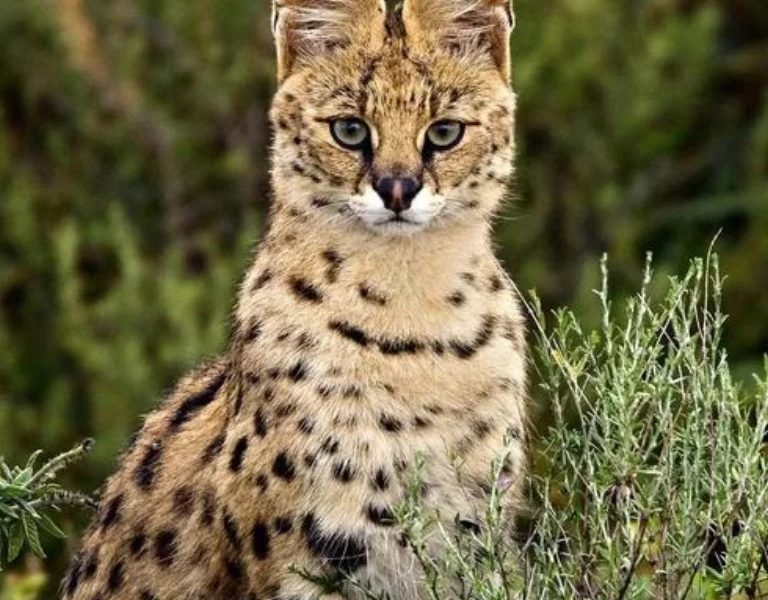
The Serval’s appearance is immediately striking and unmistakable. No other cat combines such elegant proportions with such specialized hunting adaptations. They are medium-sized cats that appear larger due to their long legs and substantial build.
Physical Dimensions:
| Measurement | Male Average | Female Average | Notes |
| Weight | 20-40 lbs | 20-35 lbs | Lean, muscular build |
| Height at Shoulder | 21-24 inches | 20-22 inches | Tallest wild cat relative to weight |
| Body Length | 26-39 inches | 24-36 inches | Excluding tail |
| Tail Length | 12-18 inches | 10-16 inches | Relatively short |
| Ear Height | 3-4 inches | 3-4 inches | Largest ears of any cat |
The Iconic Features
The Ears:
Servals possess the largest ears relative to body size of any cat species. These remarkable auditory organs serve as sophisticated hunting equipment.
- • Size: Up to 4 inches in length
- • Mobility: Can rotate 180 degrees independently
- • Acuity: Can detect prey underground or in dense grass
- • Thermoregulation: Help dissipate heat in hot climate
- • Communication: Position indicates mood and intent
The Legs:
A Serval’s legs are proportionally the longest of any cat, giving them a distinctive “stilt-walker” appearance.
- • Proportion: Legs make up significant portion of total height
- • Musculature: Powerful hind legs for explosive leaping
- • Function: Allow Servals to see over tall grass
- • Leaping Ability: Can jump 10+ feet vertically
- • Running Speed: Bursts up to 50 mph
The Coat:
The Serval’s coat is a masterpiece of natural camouflage, perfectly adapted to the dappled light of savannah grasslands.
Coat Characteristics:
| Feature | Description | Function |
| Base Color | Tawny gold to buff | Blend with dry grass |
| Spots | Large, widely spaced | Break up outline in shadows |
| Pattern | Variable by region | Local adaptation |
| Texture | Short, dense | Protection and camouflage |
| Belly | Lighter, often white | Counter-shading |
Color Variations:
- • Standard: Tawny with black spots
- • Melanistic: Black Servals (rare, found in highland areas)
- • White Servals: Extremely rare, usually leucistic
- • Regional Variations: Lighter in dry areas, darker in forests

Behavior and Hunting: The Ultimate Predator
Hunting Techniques
The Serval is one of the most successful hunters in the animal kingdom, with a hunting success rate estimated at 50%—far higher than lions (30%) or leopards (14%). This extraordinary efficiency results from specialized hunting techniques refined over millions of years.
Primary Hunting Methods:
1. The Stalk and Pounce: Slow approach through grass, explosive leap
2. The Vertical Leap: Jumping up to 10 feet to catch birds mid-flight
3. The Ear Scan: Using large ears to locate prey underground
4. The Bat: Swatting prey with rapid paw strikes
5. The Dig: Excavating rodents from burrows
Prey Preferences:
| Prey Type | Percentage of Diet | Hunting Method |
| Rodents | 80-90% | Ear detection, pounce |
| Birds | 5-10% | Vertical leap, stalk |
| Reptiles | 5-10% | Pounce, quick strike |
| Fish | Occasional | Quick paw scoop |
| Insects | Supplemental | Opportunistic |
The Legendary Leap
Perhaps the most spectacular of Serval hunting behaviors is their ability to leap incredible heights to catch birds. This behavior has made them famous among wildlife enthusiasts.
Leaping Statistics:
- • Vertical Jump: Up to 10-12 feet
- • Horizontal Leap: Up to 12 feet
- • Success Rate: Approximately 50% for bird hunts
- • Preparation: Crouch, focus, explosive extension
- • Landing: Graceful, immediate follow-through
Activity Patterns
Servals are primarily crepuscular and nocturnal, hunting during the cooler hours of dawn and dusk. However, they may be active during the day in cooler weather or when prey is abundant.
Daily Routine:
- • Dawn: Peak hunting activity
- • Daytime: Rest in dense vegetation or abandoned burrows
- • Dusk: Secondary hunting period
- • Night: Continued hunting, territory patrol
- • Rain: Often hunt more actively
Territorial Behavior
Servals are solitary and territorial animals, with home ranges that vary significantly based on habitat quality.
Territory Characteristics:
- • Size: 4-12 square miles (10-30 km²)
- • Marking: Scent marking, scratch marks, vocalizations
- • Overlap: Some overlap between adjacent territories
- • Defense: Aggressive defense against intruders
- • Dispersal: Young adults leave to establish own territories

Conservation: Protecting Africa’s Graceful Hunter
Current Status
The Serval is currently listed as “Least Concern” by the IUCN, but this status masks regional variations and emerging threats. While overall populations remain stable, certain subspecies and regional populations face significant challenges.
Population Estimates:
| Region | Population Trend | Primary Threats |
| East Africa | Stable | Habitat loss, human conflict |
| Southern Africa | Stable | Protected areas, hunting |
| West Africa | Declining | Habitat destruction, poaching |
| North Africa | Critically Endangered | Range contraction |
| Urban Areas | Increasing | Adaptation to human landscapes |
Major Threats
Despite their adaptability, Servals face numerous threats from human activities.
Primary Threats:
1. Habitat Loss: Conversion of grasslands to agriculture
2. Wetland Drainage: Loss of prime hunting habitat
3. Bushmeat Trade: Hunting for fur and meat
4. Human-Wildlife Conflict: Predation on poultry
5. Road Mortality: Vehicle collisions
6. Hybridization: Interbreeding with domestic cats
Conservation Efforts
Various organizations and governments are working to protect Serval populations and their habitats.
Conservation Strategies:
- • Protected Areas: National parks and reserves
- • Habitat Restoration: Wetland conservation projects
- • Community Education: Reducing human-wildlife conflict
- • Anti-Poaching: Law enforcement in range countries
- • Research: Population monitoring and behavior studies
- • Legislation: CITES Appendix II protection
The Savannah Cat Controversy
The breeding of Savannah cats (Serval-domestic cat hybrids) has created significant controversy regarding Serval conservation and welfare.
Controversy Points:
- • Wild Capture: Some breeding stock from wild populations
- • Welfare Concerns: Hybrid health and behavioral issues
- • Legal Status: Banned or restricted in many jurisdictions
- • Conservation Impact: Potential threat to wild populations
- • Ethical Debate: Commercialization of wild species

Servals in Captivity: Care and Considerations
Legal Status
Owning a Serval is illegal or heavily restricted in most jurisdictions. Where permitted, extensive permits, facilities, and expertise are required.
Legal Restrictions:
| Region | Legal Status | Requirements |
| United States | Varies by state | Permits, facilities, expertise |
| European Union | Generally prohibited | CITES restrictions |
| Australia | Prohibited | Biosecurity concerns |
| Range Countries | Protected | No private ownership |
| Some US States | Permitted with restrictions | Licenses, inspections |
Captive Care Requirements
For those legally keeping Servals in zoos, sanctuaries, or approved facilities, specialized care is essential.
Facility Requirements:
- • Space: Large, secure outdoor enclosures
- • Enrichment: Climbing structures, hunting opportunities
- • Diet: Whole prey, specialized carnivore diet
- • Veterinary Care: Exotic animal specialists
- • Temperature: Climate control or appropriate climate
- • Security: Escape-proof, predator-proof enclosures
Behavioral Needs
Servals in captivity retain their wild instincts and require appropriate outlets for natural behaviors.
Enrichment Essentials:
- • Hunting Simulation: Food puzzles, live prey (where permitted)
- • Climbing: Vertical space, platforms, trees
- • Water Access: Pools or streams for drinking and play
- • Hiding Places: Dense vegetation, burrow-like structures
- • Sensory Stimulation: Scents, sounds, visual variety
—
The Serval in Popular Culture
Media and Entertainment
Servals have captured public imagination through various media appearances and cultural representations.
Cultural Appearances:
- • Documentaries: Featured in numerous wildlife films
- • Zoos: Popular attractions worldwide
- • Social Media: Viral videos of leaping behavior
- • Art and Literature: Depicted in African art and stories
- • Video Games: Featured in wildlife simulation games
Symbolism and Representation
The Serval has become a symbol of African wildlife and conservation efforts.
Symbolic Meanings:
- • Grace and Elegance: Representing natural beauty
- • Hunting Mastery: Symbol of predatory perfection
- • African Wilderness: Icon of savannah ecosystems
- • Conservation: Flagship species for habitat protection
- • Adaptability: Success in changing environments
—
Conclusion: Guardians of the Grasslands
The Serval stands as one of Africa’s most remarkable feline species—a testament to the power of evolution and the beauty of wild nature. Their specialized adaptations, hunting prowess, and elegant presence make them one of the most captivating animals on the continent.
However, the Serval’s future, like that of so many African wildlife species, depends on our commitment to conservation. As human populations expand and habitats shrink, the spaces where Servals can roam freely are diminishing. Protecting these magnificent cats requires protecting the grasslands, wetlands, and savannahs they call home.
The Serval reminds us that nature’s designs are often more elegant and efficient than anything humans could create. In their golden eyes, we see the spirit of Africa itself—wild, free, and utterly magnificent.
Whether glimpsed briefly in the tall grass of the Serengeti or observed in the dedicated care of conservation facilities, the Serval leaves an indelible impression. They are, in every sense, Africa’s elegant wild hunter—a species worthy of our admiration, respect, and protection.
—
Have you been fortunate enough to see a Serval in the wild? Share your experiences and thoughts on Serval conservation in the comments below!
—