The Bengal Cat: A Wild Spirit in a Domestic Heart
Unveiling the exotic beauty, boundless energy, and captivating personality of the world’s most leopard-like feline companion.
—
Introduction: Where the Wild Meets the Living Room
In the world of domestic cats, few breeds capture the imagination quite like the Bengal. With their glittering, leopard-spotted coats and athletic, muscular builds, these cats represent the dream of owning a piece of the wild—without sacrificing the companionship of a loving pet. The Bengal is not merely a cat; it’s a conversation starter, a living work of art, and a perpetual motion machine all rolled into one stunning package.
The Bengal cat’s journey from controversial hybrid to beloved companion is a testament to human ingenuity and the enduring appeal of the exotic. These cats don’t just live in your home; they transform it into a jungle gym, a hunting ground, and a stage for their endless acrobatic performances.

Origins: A Controversial Beginning to Beloved Breed
The Jean Mill Legacy
The Bengal cat’s story begins in the 1960s with Jean Sugden Mill, a California breeder with a visionary idea: to create a domestic cat that possessed the wild beauty of an Asian Leopard Cat (Prionailurus bengalensis) but the gentle temperament of a house cat. This ambitious goal would take decades to achieve and spark debates that continue in some circles today.
The Foundation Story:
Jean Mill’s journey began when she acquired a female Asian Leopard Cat named Malaysia. When Malaysia was bred with a domestic black tomcat, the resulting kittens displayed the wild beauty Jean had envisioned. However, the early generations (F1, F2, F3) retained too much wild behavior to be suitable pets.
Through careful selective breeding over many generations, Jean and subsequent breeders worked to:
- • Preserve the stunning wild appearance
- • Eliminate aggressive or fearful behaviors
- • Develop a truly domestic temperament
- • Establish consistent breed standards
Generational Breakdown:
| Generation | Wild Ancestry | Characteristics |
| F1 | 50% Asian Leopard Cat | Often wild, not suitable as pets |
| F2 | 25% Asian Leopard Cat | Variable temperament |
| F3 | 12.5% Asian Leopard Cat | Beginning to show domestic traits |
| SBT (Stud Book Tradition) | 4+ generations removed | Fully domestic, breed standard |
The Road to Recognition
The Bengal’s path to breed recognition was paved with controversy. Early critics argued that creating hybrid cats was unethical and potentially dangerous. However, as later generations proved to be gentle, affectionate companions, resistance gradually gave way to acceptance.
Milestones in Bengal History:
- • 1963: First documented hybridization by Jean Mill
- • 1970s: Breeding program suspended, then resumed
- • 1983: TICA grants experimental breed status
- • 1986: First TICA championship recognition
- • 1991: CFA accepts Bengals for registration
- • 1997: GCCF recognizes the breed in UK
- • Today: One of the most popular breeds globally

Distinctive Appearance: The Leopard in Your Living Room
The Wild Look
The Bengal cat’s appearance is its most striking feature. These cats look like they belong in the jungle, not on your couch. Every aspect of their physical being speaks to their wild heritage while maintaining the proportions of a domestic cat.
Physical Characteristics:
- • Body: Long, muscular, and athletic with a wild, agile appearance
- • Head: Modified wedge with rounded contours, slightly small in proportion to body
- • Eyes: Large, almond to oval-shaped, set wide apart
- • Ears: Medium to small, rounded tips, set wide on head
- • Legs: Medium length, muscular, hind legs slightly longer
- • Tail: Thick, medium length, black tip with spotted pattern
- • Coat: Short to medium, dense, luxuriously soft
The Glittering Coat Phenomenon
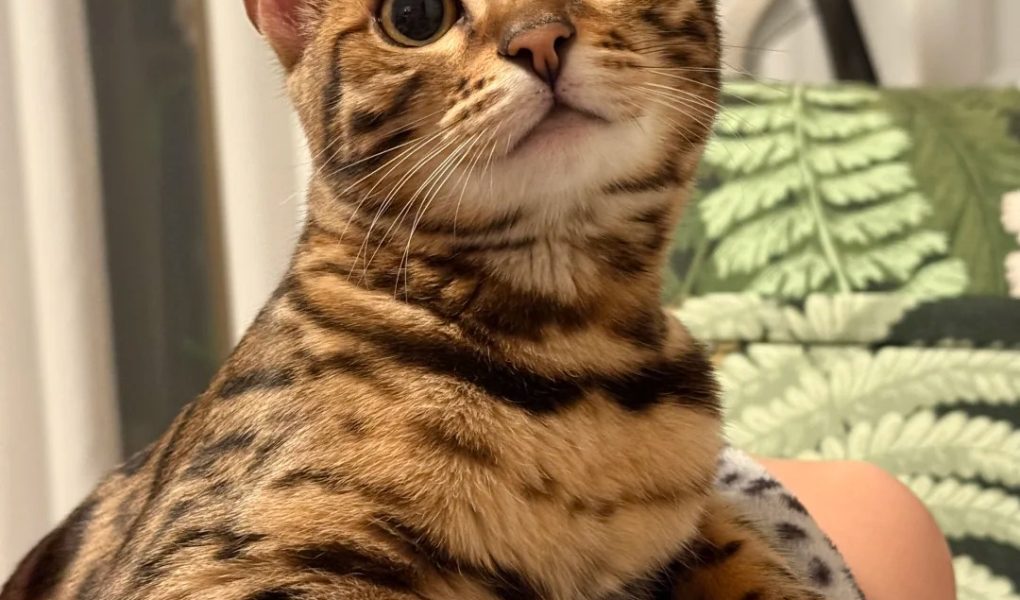
Perhaps the Bengal’s most mesmerizing feature is their “glittered” coat—a genetic trait that causes each hair to have a translucent, gold-tipped appearance. When light hits a Bengal’s coat, it appears to sparkle like gold dust has been sprinkled across their fur.
Coat Patterns:
| Pattern | Description | Appearance |
| Spotted | Round or rosetted spots | Most wild-looking, leopard-like |
| Marbled | Swirled, horizontal pattern | Flowing, artistic designs |
| Sparbled | Combination pattern | Mix of spots and marbling |
Recognized Bengal Colors:
| Color | Description | Features |
| Brown (Black) Spotted/Marbled | The classic Bengal look | Black spots on golden/orange background |
| Snow Spotted/Marbled | Lynx, mink, or sepia points | Creamy background with darker markings |
| Silver Spotted/Marbled | Silver background | Black spots on silver/white |
| Blue Spotted/Marbled | Dilute color | Blue-gray spots on cream |
| Melanistic (Black) | Solid black with ghost markings | Spots visible in certain light |
The Rosette Revolution
Modern Bengal breeding has focused heavily on developing “rosettes”—two-toned spots that resemble those of wild leopards and jaguars. These rosettes can be:
- • Arrowhead: Triangular shape pointing toward tail
- • Paw-print: Small spots clustered like toes
- • Donut: Circular spots with darker outline
- • Clouded: Large, open rosettes with irregular shapes

Personality: A Wild Spirit in Domestic Form
High Energy and Intelligence
Bengal cats are not for the faint of heart or the sedentary household. These cats possess energy levels that can only be described as “boundless” and intelligence that requires constant stimulation.
Energy Characteristics:
- • Play Drive: Intense and persistent throughout life
- • Athleticism: Exceptional jumpers, climbers, and runners
- • Curiosity: Into everything, always exploring
- • Activity Level: Require significant daily exercise
- • Nocturnal Tendencies: May be most active at dawn and dusk
The Bengal Vocal Repertoire
Bengals are notably vocal cats with a wide range of sounds that go beyond typical meowing. Their vocalizations often sound more wild than domestic.
Bengal Sounds:
- • The Chatter: Excited teeth chattering at prey
- • The Yowl: Loud, wild-sounding call
- • The Trill: Rolling “prrrrt” used as greeting
- • The Meow: Varied, often raspy or hoarse
- • The Growl: Warning sound when annoyed
Social and Affectionate
Despite their wild appearance and high energy, well-bred Bengals are typically affectionate and social with their families. They form strong bonds and often choose a favorite person.
Social Characteristics:
- • Loyalty: Often bond strongly with one person
- • Playfulness: Never really outgrow kitten behavior
- • Water Fascination: Many love playing with water
- • Height Seekers: Love to perch in high places
- • Interactive: Demand engagement and play
The Need for Stimulation
Bengals require more mental and physical stimulation than most breeds. Without adequate outlets for their energy, they can become destructive or develop behavioral issues.
Enrichment Needs:
- • Daily Play: Minimum 1-2 hours active play
- • Puzzle Toys: Food puzzles and interactive toys
- • Vertical Space: Tall cat trees and shelves
- • Window Views: Bird watching and outdoor stimulation
- • Training: Tricks and commands for mental exercise
- • Water Play: Fountains or supervised water access

Health and Care: Managing a Wild Spirit
Genetic Health Considerations
While generally healthy, Bengals are predisposed to certain genetic conditions that prospective owners should be aware of. Responsible breeders screen for these issues.
Common Health Concerns:
| Condition | Description | Screening |
| Progressive Retinal Atrophy (PRA) | Degenerative eye disorder | DNA testing available |
| Hypertrophic Cardiomyopathy (HCM) | Heart muscle thickening | Regular cardiac screening |
| Patellar Luxation | Kneecap dislocation | Physical examination |
| Erythrocyte Pyruvate Kinase Deficiency (PK Deficiency) | Red blood cell disorder | DNA testing |
| Flat-Chested Kitten Syndrome | Chest deformity in kittens | Breeder awareness |
Nutritional Requirements
Bengals have high metabolisms and require quality nutrition to support their active lifestyles and muscular builds.
Feeding Guidelines:
- • High Protein: Essential for muscle maintenance
- • Quality Ingredients: Avoid fillers and by-products
- • Portion Control: Prone to obesity if overfed
- • Hydration: Wet food recommended
- • Scheduled Feeding: Better than free-feeding
Grooming the Glittering Coat
Despite their wild appearance, Bengals have relatively low-maintenance coats. Their short to medium hair requires minimal grooming.
Grooming Routine:
- ☐ Weekly Brushing: Removes loose hair, distributes oils
- ☐ Nail Trimming: Every 2-3 weeks
- ☐ Ear Cleaning: Check and clean as needed
- ☐ Dental Care: Brush teeth or dental treats
- ☐ Bathing: Rarely needed, some enjoy water

Living with a Bengal: The Adventure Begins
The Ideal Bengal Home
Bengals thrive in environments that can accommodate their high energy and intelligence. They’re not suited for small apartments or sedentary households.
Home Requirements:
- • Space: Room to run, jump, and play
- • Vertical Territory: Tall cat trees, shelves, perches
- • Secure Windows: Screens to prevent escape during bird-watching
- • Interactive Toys: Plenty of stimulation options
- • Water Access: Fountains or supervised water play
- • Safe Outdoor Space: Catio or secure enclosure (optional)
Behavioral Considerations
Bengals are not typical lap cats and may not suit every household. Understanding their needs is crucial for a successful relationship.
Potential Challenges:
- • Destructive Behavior: Without adequate stimulation
- • Noise Level: Vocal and active, especially at night
- • Escape Artists: May try to get outside
- • Water Mess: May play in water bowls
- • Demanding: Require significant time and attention
- • Predatory Instinct: Strong hunting drive
Multi-Pet Households
Bengals can do well with other pets, but their high energy and dominant personality require careful introductions.
Compatibility:
- • Other Cats: Best with cats of similar energy levels
- • Dogs: May get along with active, cat-friendly dogs
- • Small Pets: Strong prey drive—supervise carefully
- • Children: Good with respectful, active children
—
The Bengal in Modern Culture
Popularity and Recognition
The Bengal has become one of the most popular and recognizable cat breeds worldwide, prized for their exotic appearance and engaging personalities.
Popularity Factors:
- • Exotic Appearance: Looks like a wild cat
- • Active Lifestyle: Appeals to active owners
- • Intelligence: Trainable and interactive
- • Social Media Appeal: Photogenic and entertaining
- • Celebrity Pets: Owned by numerous celebrities
Famous Bengals
Several Bengals have achieved fame through social media, shows, or unique achievements.
Notable Bengals:
| Name | Claim to Fame | Details |
| Thor | Instagram Star | 200k+ followers, stunning rosettes |
| Suki | Adventure Cat | Travels the world with owner |
| Millwood Inner Circle | Foundation Cat | Influential in breed development |
| various show cats | Championship Winners | Multiple titles worldwide |
Ethical Breeding Considerations
As Bengal popularity has grown, ethical breeding practices have become increasingly important to preserve health and temperament.
Ethical Priorities:
- • Health Testing: PRA, HCM, PK Deficiency screening
- • Temperament: Selecting for domestic, friendly nature
- • Wild Blood Limits: SBT cats only (4+ generations)
- • Education: Teaching owners about Bengal needs
- • Rescue Support: Addressing abandonment issues
—
Conclusion: A Wild Heart for the Brave Owner
The Bengal cat represents one of the most successful attempts to bring the beauty of the wild into domestic companionship. These cats offer an experience unlike any other—living with a creature that looks like it belongs in the jungle but sleeps on your pillow.
However, the Bengal is not a cat for everyone. Their high energy, intelligence, and demanding nature require owners who are prepared for a truly interactive relationship. These cats don’t just share your home; they transform it into an adventure playground.
For those willing to meet their needs for stimulation, activity, and engagement, the Bengal offers a feline experience of unparalleled intensity and beauty.
They are living proof that the wild and the domestic can coexist beautifully—provided you’re ready for the ride of your life.
—
Do you share your life with a Bengal? Share your wild stories and photos in the comments below!
—
_1_nini粘fufu_来自小红书网页版-320x200.jpg)